Corwyn Corbray
Fire & BloodCorwyn Corbray was a knight of House Corbray, remembered both for carrying the Valyrian steel sword Lady Forlorn and for the violent end of his attempt to restore order in the Vale. As a royal regent and the husband of Rhaena Targaryen, he became entangled in a succession dispute that placed the Iron Throne’s authority against the claims and armed loyalties of the Vale’s houses. His death at Runestone made the conflict harder to contain: what began as an effort to enforce a judgment became a renewed war.
Identity and Background
Corwyn was the younger son of an ancient and honorable house. By the time he became a candidate for Rhaena Targaryen’s hand, he was thirty-two and already had two daughters from an earlier marriage. He was not a youthful or untested suitor: he had a reputation as a distinguished knight, and his late father had entrusted him with Lady Forlorn, the Valyrian steel blade associated with the Corbrays. His elder brother, Leowyn Corbray, held the office of Protector of the Realm, giving the family a prominent place in royal affairs as well as in the Vale.
Corwyn’s political and military standing came to the fore during the crisis following the death of Aegon II. As the Vale’s succession conflict threatened the peace, he appeared among the leaders of a force approaching King’s Landing. Leowyn was marching from Maidenpool with Lord Mooton, Lord Brune, and Ser Rennifer Crabb; Corwyn had left Duskendale at the same time to join his brother. His party included Clement Celtigar, heir to Lord Bartimos, and Lady Staunton, the widow of Rook’s Rest. The account presents him not only as a celebrated bearer of a family sword, but as a member of a wider coalition of lords and nobles moving amid the unsettled aftermath of the civil war.
Marriage and Royal Service
Rhaena’s marriage to Corwyn began with a choice she was allowed to express. When the regents considered whom she should marry, she said she would accept the king and council’s decision, but hoped for a husband neither too old nor too heavy, and one who was kind, gentle, and noble. Asked whether she had a preference among her suitors, she named Corwyn, whom she had first met in the Vale while she was a ward of Jeyne Arryn. The match therefore joined a royal princess to a knight already connected to the region where she had lived and formed relationships.
The regents had practical reasons to hesitate. Corwyn was a second son, a mature man with two daughters from his previous marriage, rather than a young heir. Yet his personal reputation, the antiquity of House Corbray, and his possession of Lady Forlorn made him difficult to dismiss. His brother’s position as Protector of the Realm strengthened the match’s political importance. The council arranged a rapid betrothal and wedding, completed within a fortnight. The haste reflected the regents’ concern that Baela, Rhaena’s twin sister, might already be pregnant after her own marriage; they wanted Rhaena wed quickly in case the succession arrangements required an heir through her.
Corwyn later gained a place on the council as a regent. When Manfryd Mooton, the last of Aegon’s original regents, died, Lord Rowan selected Corwyn to take his place. His marriage to Rhaena thus coincided with a formal role in the government. The appointment also connected his personal standing in the Vale to the regency’s responsibility for preserving the king’s peace across the realm.
The Vale Succession Dispute
In 135 AC, conflict in the Vale persisted because the Arryn claimants refused to come to King’s Landing and submit their dispute to the regents’ judgment. Lord Thaddeus Rowan responded by sending a thousand men to Gulltown under Corwyn’s command. The force was intended to restore the King’s Peace and resolve the question of succession. Corwyn was therefore not merely a judge acting at a distance: he led royal troops into a contested region to give the regency’s decision practical force.
The dispute centered on the authority of Jeyne Arryn’s will. Corwyn ruled that her wishes should stand and declared Joffrey Arryn the rightful Lord of the Eyrie. When the opposing claimants refused to accept his ruling, he imprisoned the Gilded Falcon and his sons and executed Eldric Arryn. Eldric’s father, Ser Arnold, escaped and took refuge at Runestone, where he had once served as a squire. Corwyn pursued him there, bringing the regency’s enforcement effort into direct confrontation with Gunthor Royce, the elderly lord of Runestone known in the Vale as the Bronze Giant.
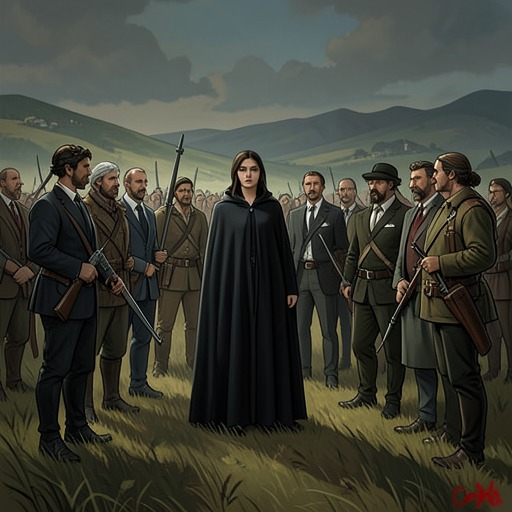
Gunthor came out in ancient bronze armor to face Corwyn. Their words escalated from argument to curses and threats. Corwyn drew Lady Forlorn; the account leaves uncertain whether he meant to strike Gunthor or only to threaten him. A crossbowman on Runestone’s battlements then shot Corwyn through the breast. The account does not resolve what Corwyn intended with the sword, but it makes clear that the immediate confrontation, amid an attempt to seize Ser Arnold, ended with the regent dead.
Death and Consequences
Corwyn’s killing was treated as an act of treason, equivalent to an attack on the king, because he had been one of the royal regents. The death also had consequences beyond his office. He was the uncle of Quenton Corbray, Lord of Heart’s Home, the husband of Rhaena Targaryen, the brother-in-law of Baela Targaryen, and, through that marriage, kin to Alyn Oakenfist. His position tied together royal government, House Corbray, and the family of the two Targaryen sisters; his death gave each connection a stake in the violence that followed.
The Vale divided into armed camps. The Corbrays, Hunters, Craynes, and Redforts supported Joffrey Arryn, the heir Corwyn had recognized. The Royces of Runestone and Ser Arnold were joined by the Templetons, Tolletts, Coldwaters, and Duttons, along with lords of the Fingers and the Three Sisters. Gulltown and House Grafton continued to back the imprisoned Gilded Falcon. The regency’s decision had not settled the inheritance: Corwyn’s attempt to enforce it had made the competing alignments more explicit and the conflict more dangerous.
From King’s Landing, Lord Rowan sent a final set of ravens ordering supporters of Ser Arnold and the Gilded Falcon to lay down their arms. When no answer came, he consulted Alyn Oakenfist and prepared to end the rebellion by force. With the mountain road expected to become passable in spring, an army set out under Ser Robert Rowan; forces from Maidenpool, Darry, and Hayford joined it, followed by six hundred Freys and a thousand Blackwoods under Benjicot Blackwood. The campaign that followed Corwyn’s death shows the cost of the failed settlement: his judgment had been an instrument of royal order, but his death turned its enforcement into a larger military undertaking.